Market Intelligence
Dubai South Investment Intelligence 2026: What the Transaction Boom Really Means for Investors
Dubai South has become one of the most active property locations in Dubai in 2026.
The headline numbers are difficult to ignore. Dubai South moved from 906 reported transactions in January to the top of Dubai's area rankings by transaction volume in March. It remained at the top through the following completed months in the DXBinteract monthly series, with June reaching 2,917 transactions worth AED 3.12 billion.
But transaction volume alone is not an investment thesis.
For investors, the more important questions are what is driving those transactions, how much activity is off-plan rather than resale, which developers and projects are creating the volume, whether price growth is keeping pace with transaction growth, and whether future infrastructure and end-user demand can absorb the supply now being launched.
This AIN Global research note separates those questions.
AIN Global view: Dubai South's rise is supported by major infrastructure and economic investment, but its 2026 property transaction boom is overwhelmingly a primary-market story. Investors should distinguish between launch liquidity, secondary-market liquidity and actual like-for-like appreciation before selecting a project.
1. Data methodology: why "Dubai South" needs careful definition
How we define Dubai South
Dubai Land Department (DLD) is the primary authority for registered Dubai property transactions.
The DLD open-data register includes transaction date, transaction type, registration type, area, property type, amount, size, master project and project. This makes it the appropriate underlying source for transaction analysis.
However, "Dubai South" is also a consumer-facing master-community name. In the DLD register, much of the broader location is recorded under the administrative area Madinat Al Mataar. Market-data providers can also aggregate projects into broader Dubai South definitions.
This creates small differences between reputable datasets.
For example, one DLD-derived final August extraction recorded 1,925 Dubai South sales, while DXBinteract's primary-market ranking recorded 1,908 off-plan sales. These numbers answer different questions and should not be presented as though they are the same metric.
For this article:
- The monthly market-ranking series uses DXBinteract reporting.
- Detailed August pricing and off-plan share use a separate DLD-derived final month-end extraction and are identified as such.
- Historical comparisons are only made when the definitions are sufficiently clear.
- September 2026 is treated as an incomplete period and is not compared directly with a completed month.
Primary source: Dubai Land Department --- Real Estate Data
DXBinteract monthly reports: DXBinteract --- Dubai Property Market
Understanding Dubai South
Dubai South should not be viewed as a single homogeneous property market. It is a large master-planned urban destination containing districts serving different residential, aviation, logistics, commercial and humanitarian functions.
The official masterplan below provides geographic context for the transaction analysis that follows.
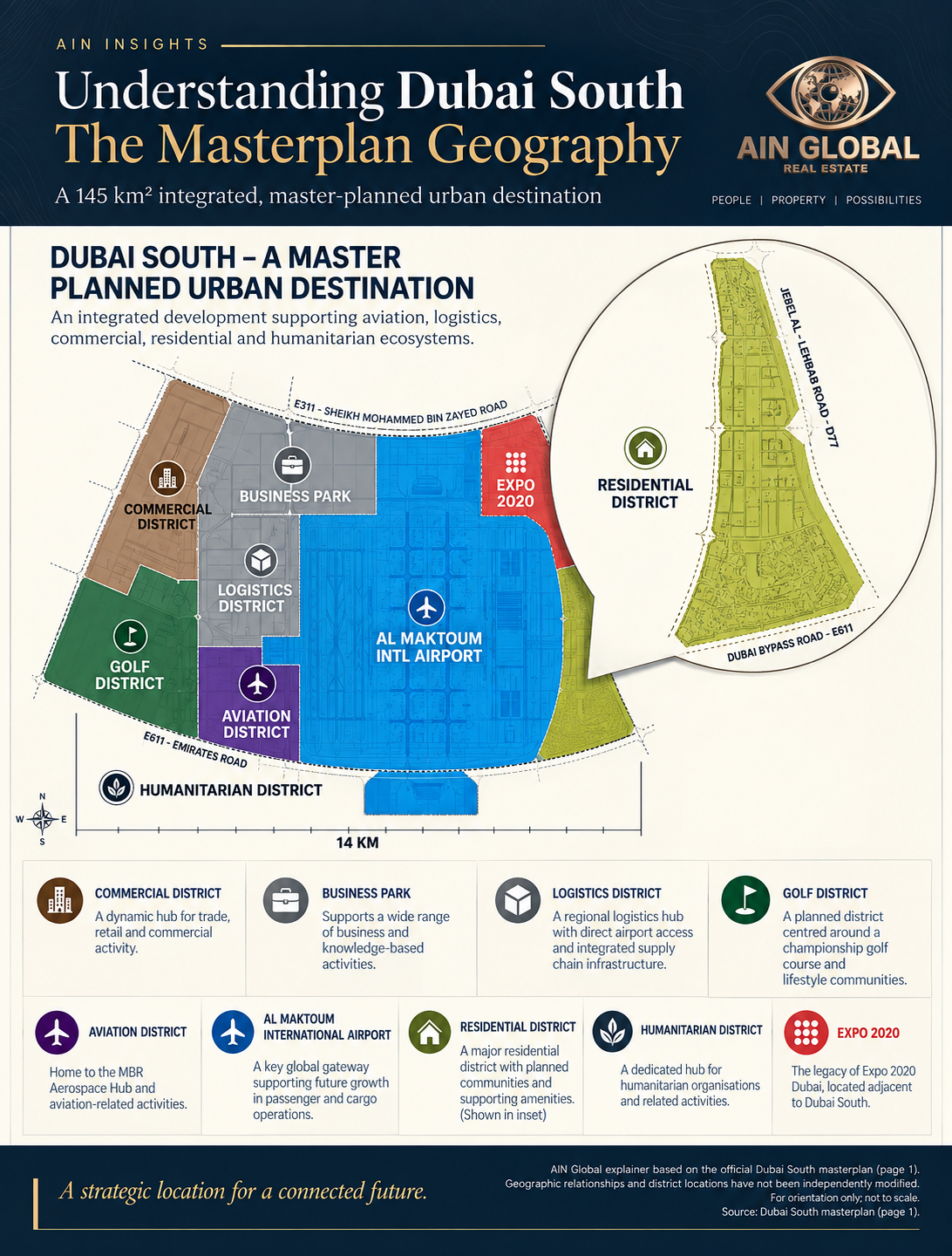
Figure 1 — Understanding Dubai South: official masterplan geography and principal districts.
AIN Global explainer based on the official Dubai South masterplan image provided for this article. Geographic relationships and district locations have not been independently modified. For orientation only; not to scale.
“Dubai South” is the macro location. Investment performance must ultimately be assessed at district, developer, project, phase and unit level.
2. Dubai South transactions: January to August 2026
The completed-month series shows how quickly Dubai South moved up Dubai's transaction rankings.
| Month | Dubai South transactions | Reported value | Dubai ranking / context |
|---|---|---|---|
| January 2026 | 906 | — | 4th by transaction volume |
| February 2026 | 965 | — | 2nd by transaction volume |
| March 2026 | 1,000 | AED 1.69bn | 1st by transaction volume |
| April 2026 | 1,157 | AED 1.93bn | 1st by transaction volume |
| May 2026 | 1,353 | AED 1.49bn | 1st by transaction volume |
| June 2026 | 2,917 | AED 3.12bn | 1st by volume and value |
| July 2026 | 2,351 | AED 2.6bn | 1st by transaction volume |
| August 2026 | 1,908 off-plan | AED 2.3bn off-plan | 1st in primary sales for sixth consecutive month |
| September 2026 | Incomplete | Incomplete | Do not compare with a full month |
Important: August's DXBinteract figure is explicitly a primary/off-plan figure, while January--July area rankings refer to reported area transaction volume. It should therefore not be summed blindly with the preceding months as one homogeneous series.
What changed during the year?
January began with 906 transactions, placing Dubai South fourth by volume.
By February, 965 transactions moved it into second place.
In March, Dubai South reached 1,000 transactions worth AED 1.69 billion and became Dubai's highest-volume area in the DXBinteract ranking.
Activity then increased to 1,157 transactions in April and 1,353 in May.
June was exceptional. Dubai South recorded 2,917 transactions worth AED 3.12 billion, leading Dubai by both transaction volume and value in the DXBinteract monthly report.
July remained very active at 2,351 transactions worth AED 2.6 billion. Of these, DXBinteract data reported 2,231 off-plan transactions worth AED 2.3 billion.
In August, Dubai South remained Dubai's leading primary-market area for a sixth consecutive month, recording 1,908 off-plan transactions worth AED 2.3 billion.
The correct conclusion is therefore not that transaction volume rises every month. It does not.
The more useful conclusion is that Dubai South established sustained high transaction depth during 2026, and that the later months show this activity is heavily driven by off-plan registrations.
Monthly-series sources
- DXBinteract --- Dubai Property Market monthly reports
- DXBinteract --- March 2026
- July 2026: DXBinteract data, 2,351 transactions / AED 2.6bn, including 2,231 off-plan / AED 2.3bn.
- August 2026: DXBinteract data, 1,908 primary transactions / AED 2.3bn.
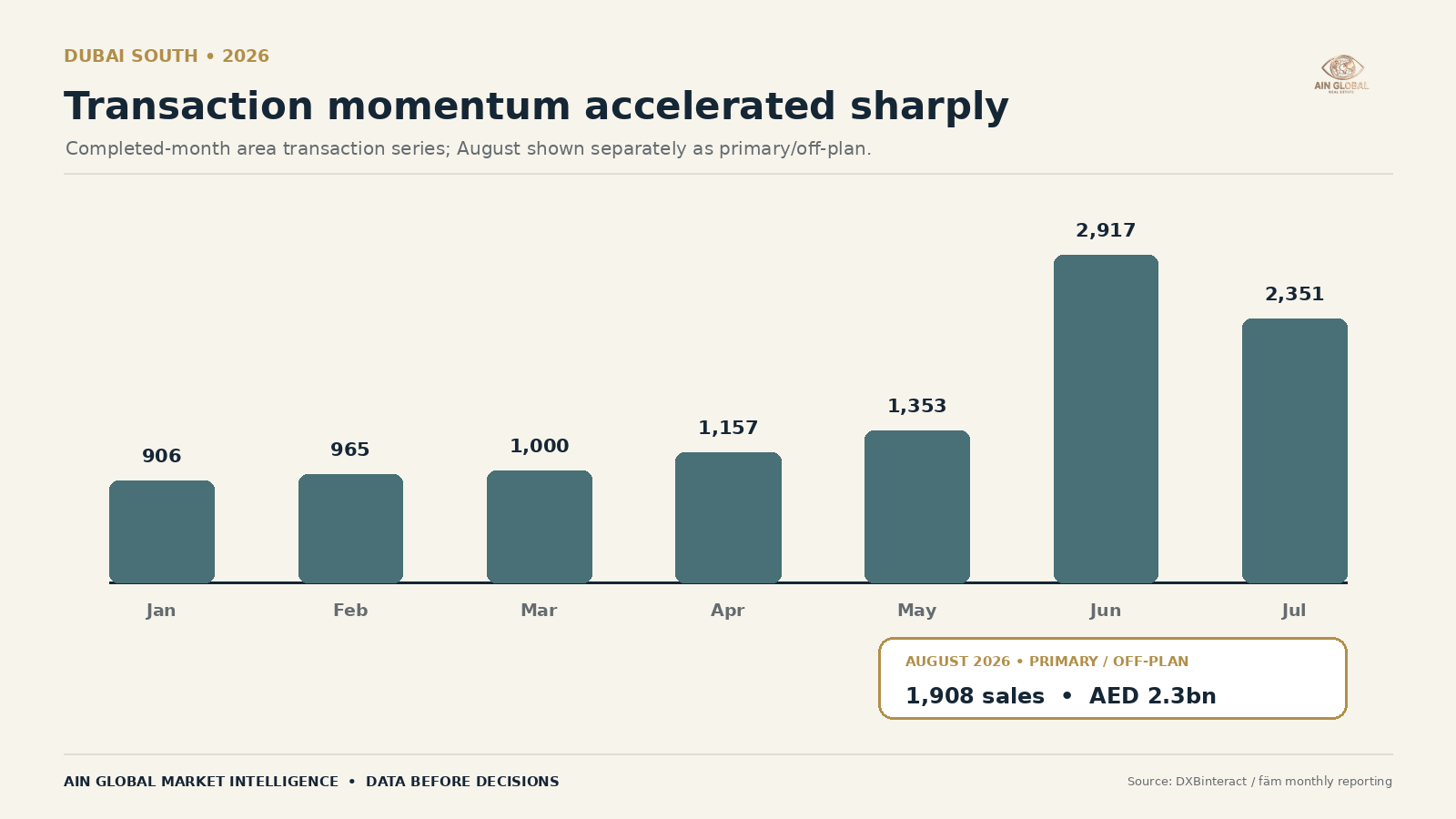 Source: DXBinteract monthly reporting
Figure 2 — Dubai South transaction momentum during 2026. August is shown separately because the cited 1,908 figure is explicitly primary/off-plan.
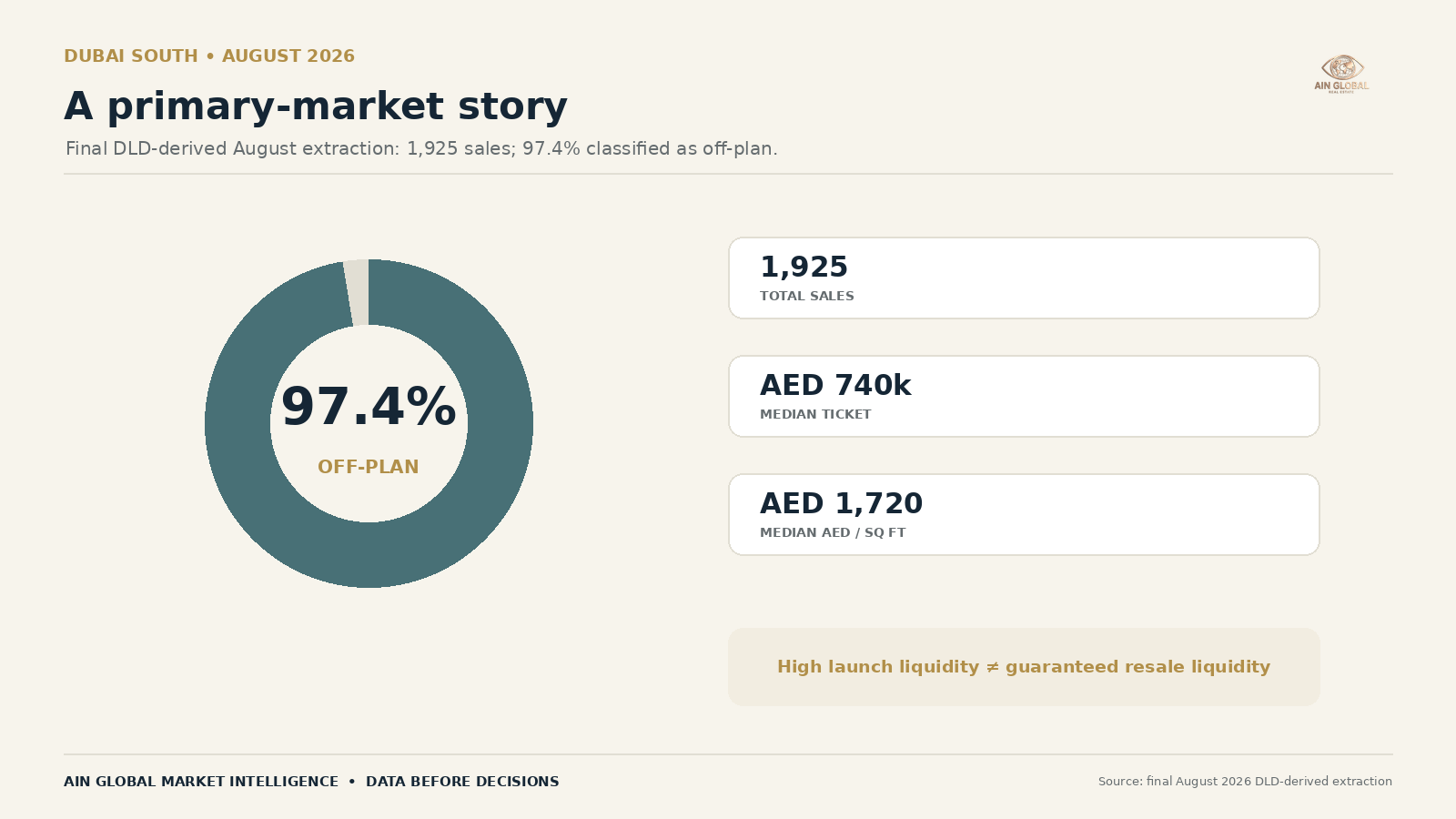
Figure 3 — August 2026's registered mix was overwhelmingly off-plan, reinforcing the distinction between primary-market and resale liquidity.
3. August 2025 versus August 2026: how large was the change?
A DLD-derived August 2025 residential dataset recorded 645 Dubai South sales, including 551 off-plan transactions.
A final DLD-derived August 2026 extraction recorded 1,925 Dubai South sales, with 97.4% classified as off-plan. This corresponds to approximately 1,875 off-plan registrations in that extraction.
On those datasets, total registered activity increased from 645 to 1,925 --- almost three times the prior-year count.
However, AIN Global does not present a precise percentage as an official DLD YoY index because the two figures come through different downstream extraction/classification methodologies.
The safer conclusion is:
August 2026 registered sales activity in the broader Dubai South dataset was roughly three times the level reported in August 2025. Off-plan activity expanded even more strongly.
The 2025 dataset recorded 551 off-plan sales. DXBinteract recorded 1,908 primary sales in August 2026, while the alternative DLD extraction implies roughly 1,875 off-plan registrations. Either way, the direction and scale of the increase are clear.
Source for August 2025: McCone Properties --- DLD August 2025 market data
Source for final August 2026 extraction: PalmObserver --- August 2026 DLD area data
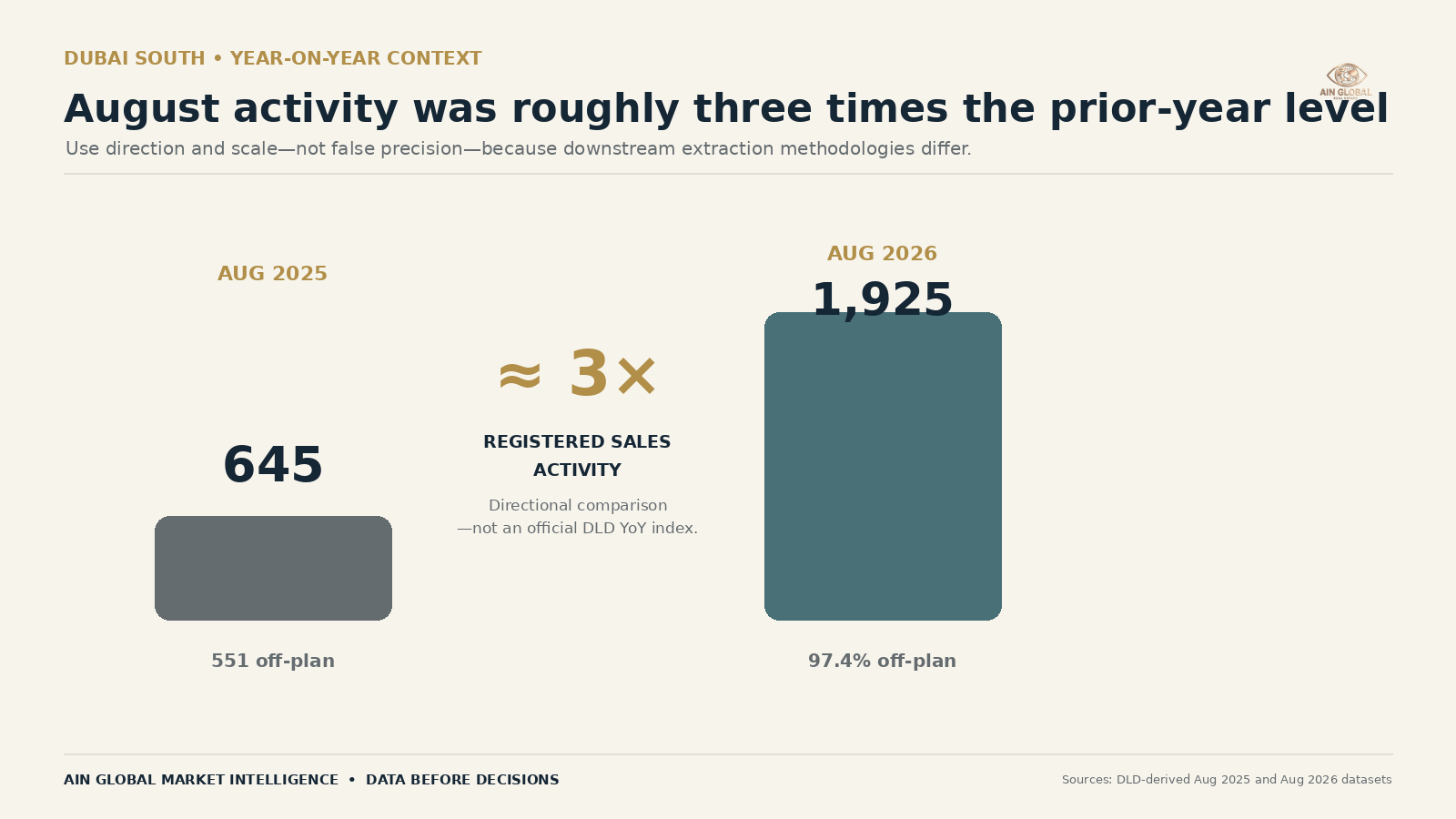
Figure 4 — August registered activity was roughly three times the prior-year level in the cited DLD-derived datasets. This is directional rather than an official DLD YoY index.
4. The most important statistic: Dubai South is overwhelmingly off-plan
The headline transaction count needs context.
A final DLD-derived July extraction recorded:
- 2,357 sales
- 96.5% off-plan
- Median transaction price: AED 730,000
- Median price: AED 1,700/sq ft
The final August extraction recorded:
- 1,925 sales
- 97.4% off-plan
- Median transaction price: AED 740,000
- Median price: AED 1,720/sq ft
This is important.
High transaction volume does not automatically mean deep resale liquidity.
Developer launches can generate hundreds or thousands of registrations. That demonstrates primary-market demand, but it does not tell an investor how easily a specific unit can later be resold, what discount or premium a resale may require, or how many competing units will reach handover at the same time.
The distinction becomes clearer when secondary-market data is isolated.
A DLD-based resale dataset recorded 993 Dubai South resales across 46 buildings/projects in the 12 months to 17 September 2026.
That is meaningful resale activity, but it is small relative to the much larger volume of primary registrations now entering the area.
For an investor, the relevant question is therefore not simply:
"How many properties are selling in Dubai South?"
It is:
"How many comparable completed properties are reselling in the project and unit type I am considering?"
Sources:
- PalmObserver --- July 2026 final DLD data
- PalmObserver --- August 2026 final DLD data
- The Dubai Desk --- Dubai South registered resales
5. Transaction growth is not the same as price growth
Dubai South's transaction count has expanded dramatically, but the price signal is more measured.
The final July DLD-derived dataset showed a median of AED 1,700/sq ft.
August increased modestly to AED 1,720/sq ft, a 1.2% month-on-month increase in that registered mix.
A broader DLD-derived Dubai South series updated in September places the district's median around AED 1,650/sq ft on its methodology and reports approximately 4% YoY growth in median AED/sq ft.
These figures are not contradictory. They use different time windows, filters and statistical treatment.
They do, however, point to the same investment lesson:
The increase in transaction volume is far larger than the observed area-level increase in price per square foot.
This suggests that a significant part of Dubai South's 2026 expansion is liquidity and supply growth --- more projects, more launches and more buyers transacting --- rather than simply rapid repricing of the same existing housing stock.
That is potentially healthier than a purely price-led boom, but it also means investors need to analyse supply.
Source: Dubai Real Estate Data --- Dubai South, DLD-derived
6. Major off-plan developers shaping Dubai South
Dubai South should not be analysed as one uniform property market. Several distinct developer ecosystems are emerging inside the wider district.
Dubai South Properties
Dubai South Properties is the master developer's residential development arm and is therefore strategically important to the district.
Its HAYAT master community spans approximately 10 million sq ft and is planned for around 2,500 residential units, including apartments, hotel apartments, townhouses, semi-detached homes, standalone villas and mansions.
In March 2026, Dubai South awarded an AED 2 billion construction contract covering multiple HAYAT phases. Initial phases are expected to complete from 2028.
Dubai South Properties also developed South Living, a 209-unit apartment project in the Residential District. Dubai South subsequently announced that South Living had sold out.
These projects matter because they represent direct master-developer supply rather than a third-party developer simply acquiring an individual plot.
Official sources:
Emaar --- Emaar South
Emaar South is a major sub-market within the broader Dubai South investment corridor.
Emaar's published masterplan states:
- 22,700 residential units
- 15,360 apartment units
- 25 neighbourhood parks
- 53,000 sqm of retail and dining
- 18-hole championship golf course
Current and recent Emaar South inventory includes multiple apartment, townhouse and villa phases.
This creates a different investment proposition from the high-volume apartment launches elsewhere in Dubai South: branded master-community positioning, golf-course amenity, established Emaar delivery history and a larger family-housing component.
Official source: Emaar --- Emaar South
Azizi Developments --- Azizi Venice
Azizi Venice is one of the most important contributors to Dubai South's off-plan transaction volume.
DLD-derived project records show the scale clearly.
Azizi Venice 6 recorded more than 900 DLD-registered sales during 2026 in data captured during September, with studios forming the majority of registrations.
Azizi Venice 12 recorded 583 sales from January through August 2026, again entirely off-plan in the dataset.
A wider DLD off-plan extraction captured Azizi Venice 14 with more than 1,900 registered 2026 sales, making it one of Dubai's busiest individual off-plan projects.
The significance is not that one project is necessarily better or worse than another.
It is that Azizi Venice phases are sufficiently large to materially influence Dubai South's area-wide transaction statistics.
An investor should therefore avoid interpreting Dubai South's transaction count as evenly distributed demand across every development.
Sources:
- DXBinteract --- Azizi Venice project analysis
- DLD-derived project-level transaction datasets, September 2026.
BT Properties
BT Properties is developing a large gated master community in Dubai South's Golf District.
Its planned product mix includes villas, townhouses, apartments, retail, healthcare, education and landscaped public areas.
This is relevant because Dubai South's next stage is no longer exclusively an apartment-led story. Larger family-oriented master communities are increasingly part of the pipeline.
Official source: BT Properties --- Dubai South
Majid Al Futtaim + Dubai South
One of the most significant future additions is the AED 62 billion mixed-use master community announced by Dubai South and Majid Al Futtaim in May 2026.
The planned development covers 22 million sq ft and will combine residential, retail and lifestyle uses, anchored by a major shopping mall.
This should be treated as a future supply and demand catalyst, not as existing transaction evidence.
Its importance is strategic: a developer/operator of Majid Al Futtaim's scale committing AED 62 billion to Dubai South materially expands the area's planned retail, residential and lifestyle ecosystem.
Official source: Dubai Media Office --- Dubai South and Majid Al Futtaim AED 62bn partnership
The long tail of newer developers
Beyond the major master developers, Dubai South now contains a rapidly expanding group of smaller and mid-sized off-plan developers.
This increases buyer choice but also increases the importance of developer-level due diligence.
For these projects, investors should examine:
- DLD/RERA project registration and escrow arrangements.
- Developer delivery history.
- Construction progress.
- Payment-plan structure.
- Launch price versus registered comparable sales.
- Service-charge assumptions.
- Handover clustering and competing supply.
- Resale restrictions and assignment terms.
- Actual unit efficiency rather than headline price alone.
- Comparable ready-property rents and resales.
AIN Global does not recommend treating all Dubai South off-plan supply as interchangeable.
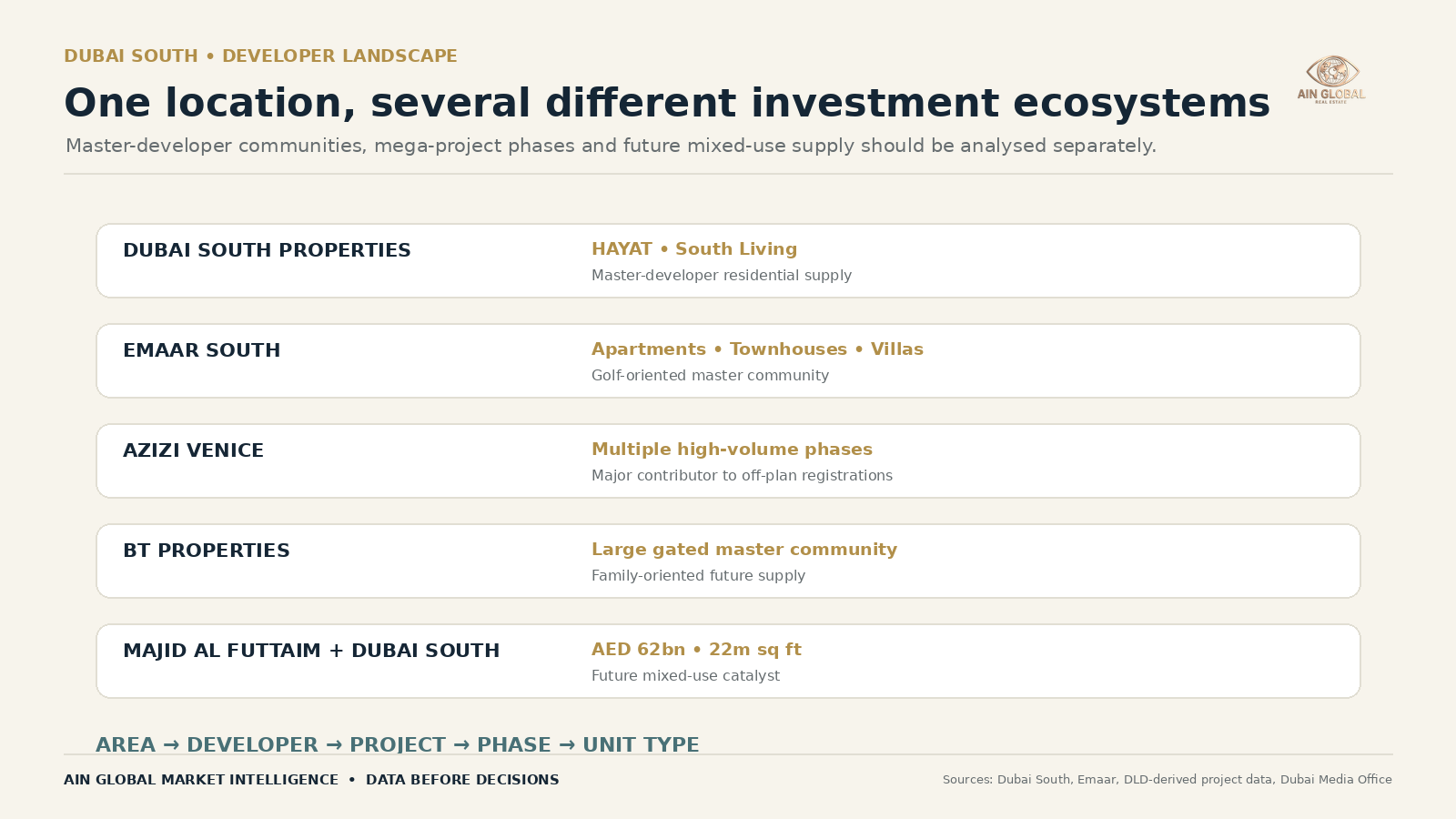
Figure 5 — Dubai South contains several distinct developer ecosystems. Area-wide statistics should be decomposed to project and phase level.
7. Developer concentration changes how the transaction numbers should be read
Dubai South's volume leadership is genuine, but individual mega-projects can materially affect the district total.
Azizi Venice demonstrates this particularly clearly.
When one phase can record hundreds --- or more than a thousand --- registrations, a surge in district transactions may partly reflect:
- a new launch,
- bulk registration timing,
- release of additional phases,
- attractive entry-level ticket sizes,
- payment-plan structure,
- or concentrated developer marketing.
That is different from thousands of unrelated buyers independently bidding up a mature stock of completed homes.
For investment analysis, area-level transaction volume should therefore be followed by:
Area → District → Developer → Project → Phase → Unit Type → Entry Price → Exit.
This is the level at which an investment decision becomes meaningful.
8. The demand-side argument: Al Maktoum International Airport --- and Emirates' future hub
The most important long-term infrastructure catalyst is Al Maktoum International Airport (DWC), but the investment case has become more concrete than a future-airport narrative alone.
In June 2026, the Dubai Government confirmed that the first major phase remained on course to commence operations in 2032. Contracts worth more than AED 13 billion were already under execution, with preparations underway for strategic packages exceeding AED 55 billion. At peak construction, the on-site workforce is expected to reach approximately 120,000.
The completed masterplan is designed for annual capacity exceeding 260 million passengers and 12 million tonnes of air cargo.
In September 2026, Dubai Airports CEO Paul Griffiths said development was moving "full speed ahead" and identified the opening of DWC's second runway by the end of 2027 as the next major infrastructure milestone. The first major phase is expected to provide capacity for approximately 150 million passengers annually.
Emirates is already investing around its future DWC operating base
The transition is not limited to airport construction. Emirates has begun building substantial airline infrastructure in Dubai South.
In May 2026, Emirates broke ground on a US$5.1 billion engineering complex at Dubai South/DWC, designed to handle 28 wide-body aircraft simultaneously and support the airline's long-term engineering requirements.
More importantly for the long-term demand thesis, Emirates has publicly referred to the future relocation of its operations. In its official strategic-partnership announcement with Air Canada, Emirates said the airlines would coordinate to ensure a seamless move of operations to Dubai World Central, which it said is expected after 2032.
This wording matters. It provides direct airline-level evidence that DWC is being planned as part of Emirates' future operating model, rather than relying solely on market assumptions about what the airport expansion may eventually mean.
For Dubai South property investors, the potential demand channels extend beyond passengers. The wider aviation ecosystem can support engineering, maintenance, logistics, airline staff, training, hospitality, supply-chain businesses and related employment.
However, AIN Global would still separate a confirmed infrastructure and employment catalyst from a guaranteed property-return claim. The airport and Emirates investments strengthen the demand-side case for Dubai South; they do not make every project or launch price equally attractive.
Official sources:
- Dubai Media Office --- Al Maktoum International Airport progress, June 2026
- Dubai Media Office --- Dubai Airports aviation briefing, September 2026
- Emirates --- US$5.1bn Dubai South engineering complex, May 2026
- Emirates --- future move of operations to DWC
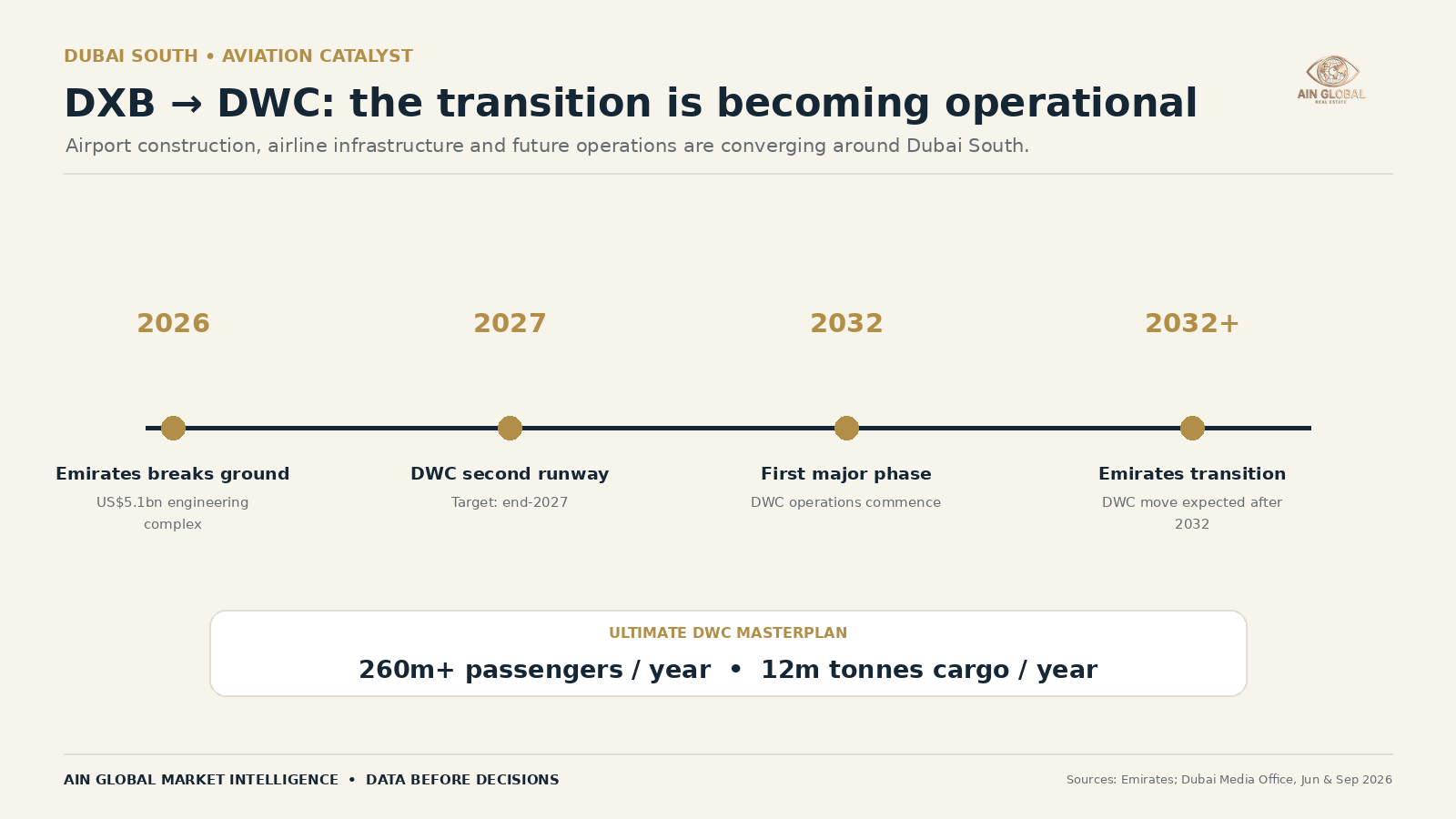
Figure 6 — Infrastructure milestones: second runway targeted for end-2027, first major phase targeted for 2032 and Emirates’ transition expected after 2032. Infrastructure and employment catalysts do not guarantee property returns.
9. The next demand catalyst: a much larger urban ecosystem
Dubai South is increasingly being developed as more than an airport-adjacent residential district.
The AED 62 billion Majid Al Futtaim partnership will add a 22-million-sq-ft mixed-use community.
Dubai South's own residential pipeline is expanding.
Emaar South continues to build out a major golf-oriented residential community.
The aviation and logistics districts continue attracting businesses and facilities.
This matters because sustainable residential demand ultimately depends on people having reasons to live in the area, not merely investors having reasons to buy there.
The investment thesis becomes stronger if infrastructure investment translates into:
- employment,
- business formation,
- schools,
- retail,
- healthcare,
- leisure,
- transport connectivity,
- and a growing permanent resident population.
Those indicators should be monitored alongside property sales.
10. The counterweight: future supply
The same factors attracting investors are attracting developers.
That creates the central Dubai South investment tension.
Demand can grow significantly --- while supply grows significantly at the same time.
The investor's question is therefore not:
"Will Dubai South grow?"
The more useful question is:
"Will demand for my particular property type grow faster than competing supply at the price I am paying?"
A studio in a high-density off-plan cluster, a townhouse in a master-planned family community, an Emaar South golf apartment and a villa close to the airport corridor should not be analysed using the same assumptions.
Future handovers need to be mapped at project and unit-type level.
11. Resale liquidity is the metric to watch next
As today's off-plan projects move toward completion, Dubai South will enter a more revealing phase.
The key indicators will become:
- number of completed-unit resales,
- days required to resell,
- resale price versus original purchase price,
- number of competing listings,
- rental absorption,
- renewal rates,
- achieved rents,
- service charges,
- and the premium or discount between new launches and comparable ready homes.
A DLD-based source records 993 resales across 46 Dubai South buildings/projects during the 12 months to 17 September 2026.
That secondary market exists.
But compared with the scale of primary registrations, it is still relatively modest.
This is one of the most important indicators AIN Global intends to monitor as the current development cycle matures.
12. September 2026: do not extrapolate the partial month
As of mid-September, a DLD-derived dataset recorded 425 Dubai South sales between 1 and 14 September.
The observed daily registration pace was below August, and approximately 89.4% of the September sample was off-plan.
But this should not be extrapolated into a September forecast.
DLD registrations can lag underlying transactions, and partial-month comparisons can be distorted by weekends, registration batches and project timing.
AIN Global will therefore wait for the completed September DLD dataset before making a September-to-September YoY comparison.
Source: PalmObserver --- September 2026 mid-month DLD data
13. What should an investor actually investigate before buying in Dubai South?
Dubai South now has enough activity that asking whether the location is "good" or "bad" is no longer useful.
The correct analysis is project-specific.
1. Identify what is driving the project's demand
Is demand coming from end users, investors, payment-plan buyers, airport-related employment, or developer marketing?
2. Compare the launch price with registered transactions
Do not compare only against another developer's brochure.
Compare AED/sq ft with actual DLD-registered transactions for similar unit types, development stages and locations.
3. Separate off-plan liquidity from resale liquidity
A project selling hundreds of units from the developer does not guarantee that an owner can resell easily before or after handover.
4. Examine future competing supply
How many studios, one-bedroom apartments, townhouses or villas are scheduled to hand over near the project?
5. Stress-test the rental assumption
Use achieved or registered rents where possible, not only developer-projected yields.
6. Assess the developer
Track record, construction progress, escrow status, delivery history and build quality matter.
7. Understand the payment plan
A long post-handover plan can support sales demand but may also affect resale competition.
8. Match the investment horizon to the infrastructure horizon
The airport's first-phase operating target is 2032. An investor planning to exit in 2027 is making a different investment from someone prepared to hold through the area's infrastructure build-out.
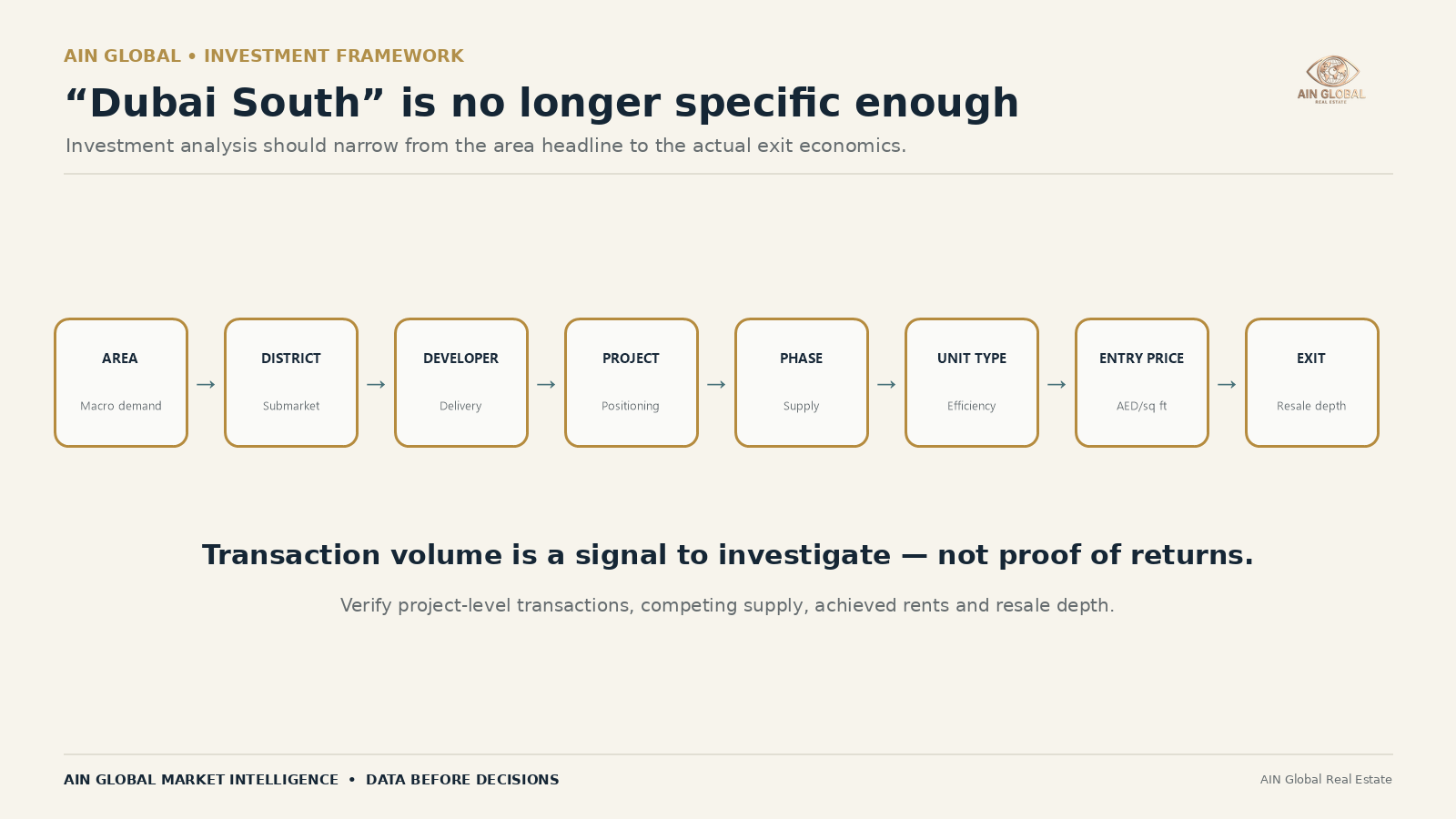
Figure 7 — AIN Global's framework for moving from an area-level thesis through district, developer, project, phase, unit type and entry price to a realistic exit assessment.
14. AIN Global interpretation
Dubai South has moved beyond being merely a speculative "future airport" story.
There is now measurable transaction depth, major residential development, large-scale government-backed infrastructure under construction and significant private-sector investment.
The 2026 data supports that conclusion.
But it also shows why investors need to be selective.
The market is currently dominated by off-plan transactions. A small number of large developments can materially influence area-wide sales volumes. Future supply is substantial. And the secondary market has not yet reached anything close to the scale of the primary market.
That creates opportunity --- but not uniform opportunity.
The strongest Dubai South investment case is therefore not simply:
"The airport is coming, so buy Dubai South."
It is:
Find the part of Dubai South where infrastructure, developer quality, entry price, product scarcity, end-user demand and future supply align --- and verify each assumption against actual transaction data.
That is the level at which Dubai South should now be analysed.
Key figures at a glance
| Indicator | Latest verified reading used in this report |
|---|---|
| Jan 2026 Dubai South transactions | 906 |
| Mar 2026 transactions | 1,000 |
| Jun 2026 transactions | 2,917 |
| Jun 2026 value | AED 3.12bn |
| Jul 2026 transactions | 2,351 (DXBinteract series) |
| Jul 2026 off-plan | 2,231 |
| Aug 2026 primary transactions | 1,908 |
| Aug 2026 primary value | AED 2.3bn |
| Final Aug DLD-derived broader extraction | 1,925 sales |
| Final Aug off-plan share | 97.4% |
| Final Aug median ticket | AED 740,000 |
| Final Aug median AED/sq ft | AED 1,720 |
| Dubai South 12-month DLD-derived sales | 16,438 through 14 Sep 2026 |
| Dubai South 12-month DLD-derived sales value | AED 26.5bn |
| Registered resales | 993 in 12 months to 17 Sep 2026 |
| HAYAT planned homes | ~2,500 |
| MAF/Dubai South future community | AED 62bn / 22m sq ft |
| Airport first-phase operations target | 2032 |
| Airport final planned passenger capacity | 260m+ annually |
| Airport final planned cargo capacity | 12m tonnes annually |
Sources and verification register
This article prioritises primary and registry-derived sources.
-
Dubai Land Department (DLD) --- official transaction and project registry
https://dubailand.gov.ae/en/open-data/real-estate-data/ -
DXBinteract --- DLD-derived monthly transaction analysis
https://dxbinteract.com/ -
Dubai Media Office --- official Al Maktoum International Airport progress update, 15 June 2026
https://www.mediaoffice.ae/en/news/2026/june/15-06/hamdan-bin-mohammed-approves-al-maktoum-airport -
Dubai Media Office --- Dubai South / Majid Al Futtaim AED 62bn master-community announcement, 19 May 2026
https://www.mediaoffice.ae/en/news/2026/may/19-05/dubai-south-and-majid-al-futtaim -
Dubai South --- official HAYAT construction update
https://www.dubaisouth.ae/en/newsroom/dubai-south-awards-aed-2-billion-contract-for-the-development-of-multiple-phases-of-hayat-project -
Emaar --- official Emaar South master-community information
https://www.emaar.com/en/our-communities/emaar-south -
PalmObserver --- DLD-derived final July/August and partial September area extracts, used only where methodology/date boundaries are explicitly stated
https://www.palmobserver.com/dubai-real-estate/dubai-property-price-update-july-2026/
https://www.palmobserver.com/dubai-real-estate/dubai-property-price-update-august-2026/
https://www.palmobserver.com/dubai-real-estate/dubai-property-price-update-september-2026/ -
McCone Properties --- DLD-derived August 2025 residential dataset
https://www.mcconeproperties.com/reports/2025-08 -
Dubai Real Estate Data --- DLD/Dubai Pulse-derived Dubai South series
https://www.dubairealestatedata.com/areas/dubai-south -
The Dubai Desk --- DLD-registered Dubai South resale analysis
https://www.thedubaidesk.com/dubai-south/
Important note
Market statistics are historical observations, not guarantees of future performance. Area-level medians can change because the mix of projects, unit sizes and property types transacting changes. Off-plan purchases also carry developer, construction, delivery, financing, supply and resale risks.
AIN Global Real Estate recommends assessing individual properties using project-level DLD transactions, developer due diligence, competing supply, achieved rents and the buyer's intended investment horizon rather than relying on area-wide headline growth alone.
AIN Global Real Estate
Data before decisions.